Alpiq plays an active role in securing Switzerland’s energy supply – both today and in the future. The company is involved in five projects under the Swiss Confederation’s Round Table Hydropower, which in 2021 selected 16 projects with the aim of achieving a production target of 2 TWh by 2040. Last year, the Swiss Federal Office of Energy (SFOE) announced that additional effort would be needed to reach this target by the deadline, and launched a new round of discussions between project leaders, authorities and NGOs. We spoke with Michaël Plaschy, Head of Hydropower Production at Alpiq, to get an overview of the current status of Alpiq’s ongoing projects.
Michaël, how are Alpiq’s Round Table projects progressing?
Alpiq is working hard to drive forward those projects that generate winter energy: the Gornerli multi-purpose reservoir and the Moiry and Emosson elevations. The company is also involved in the Sambuco project, while the Oberaletsch project has now been taken over by other partners. Considerable effort is being invested, even though progress is slow and, at times, somewhat frustrating. Studies are still underway, but each project has its own characteristics. Gornerli involves a brand-new dam, which naturally requires a longer preparation period – including the need to conclude a concession amendment. But this should not be necessary to raise the two existing dam walls. It is also worth noting that, in the case of Emosson, its binational nature calls for more complex administrative procedures due to differing legislation in Switzerland and France.
The projects are still at the study stage, yet there appears to be a discrepancy between the winter production figures announced during the 2021 Round Table and the current project figures. How do you explain this?
It is important to understand the various stages that projects of this scale have to go through. Take the case of raising the Moiry dam wall as an example. The first step is to conduct a feasibility study. At this stage, several variants are always evaluated – in this case, raising the dam wall by different heights – to keep all avenues open. The Moiry project was at this stage in 2021, with possible heights ranging from 5 m to 21 m.

As the figures change and are refined, it is a sign that the projects are moving forward.
Which option did Alpiq favour?
From the outset, we opted for an approach that eliminates the need to modify the curvature of the structure – an elevation of around 8 to 9 metres. More detailed analysis is then required, taking into account all the relevant factors: winter energy production, geology, landscape and environmental impact, precise structural stability calculations, the technical adaptations required for the existing infrastructure, legal aspects, an initial cost estimate and more besides. For the Moiry dam, these detailed studies now point to a projected elevation height of around 9 metres, yielding a winter energy reserve of approximately 50 GWh. All of this in-depth work is necessary and, as the figures change and are refined, it is a sign that the projects are moving forward.
What about the other projects – Gornerli in particular?
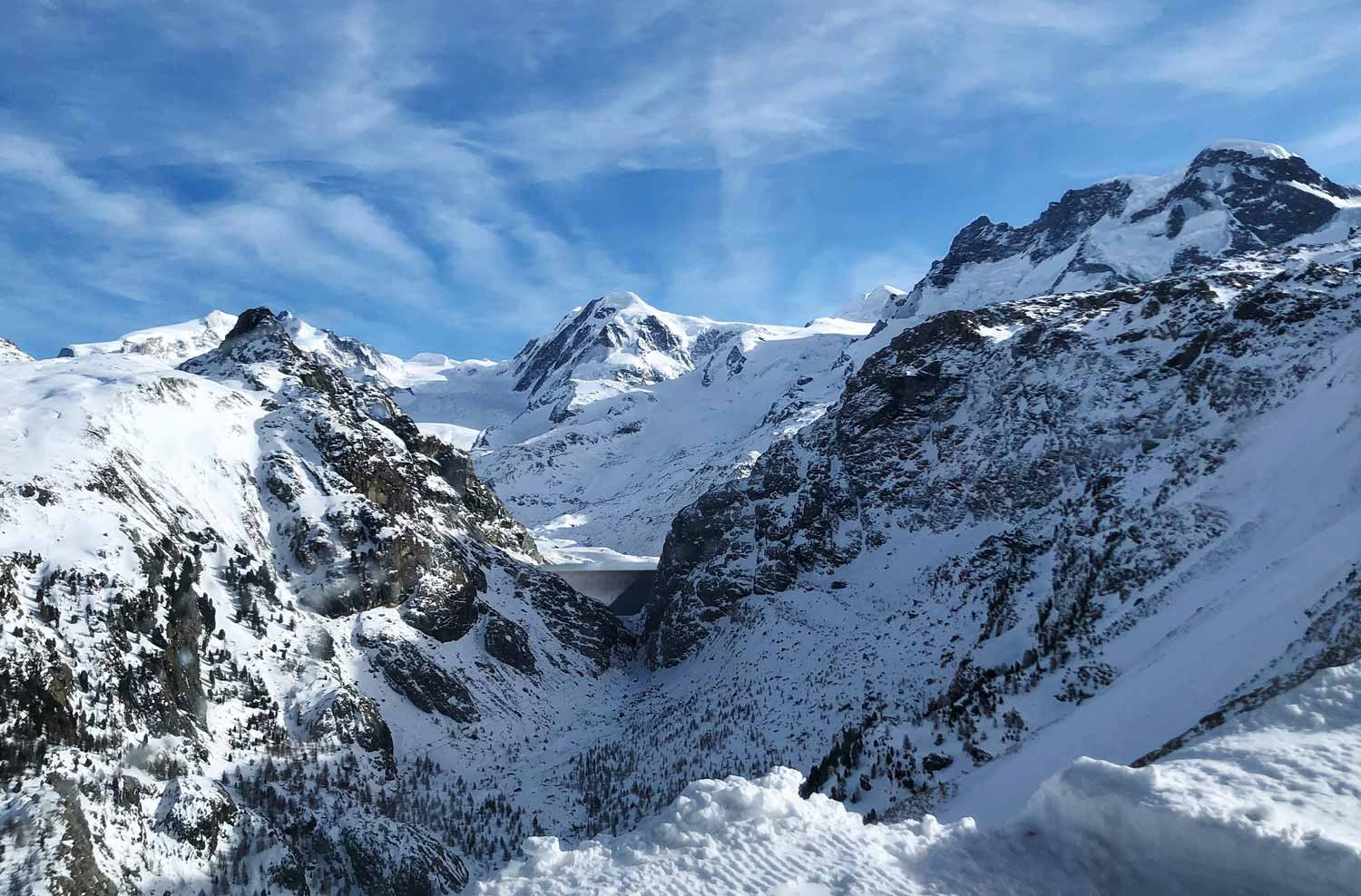
Work on the project above Zermatt is now focused on clarifying and fleshing out the various points established during the feasibility study – technical aspects, logistical solutions, finalisation of volumes, maximum winter energy production, environmental impacts and so on. The technical and environmental studies for Gornerli are still underway, in particular the hydrological studies, which still need to be aligned with the Swiss Confederation’s “Climate CH2025” study published in November 2025. Together, all of these studies will determine the final design of this project – which has to be optimised to meet needs over the timescale of a century as opposed to being designed solely with the next 20 years in mind. The project will also play a vital role in flood protection for the Zermatt region.
And what about the project to raise the wall of the Emosson dam?
For Emosson, the plan is to raise the wall by an elevation in the range of 10 metres. Analyses are still ongoing and must take into account the binational nature of the hydraulic complex. This makes the processes somewhat more complex – for example, the investment support available from the SFOE covers only half of the elevation. So we need to find alternatives to ensure the project’s economic viability.
What are the next steps?
For the Gornerli project – which makes the largest contribution to winter energy production among the 16 Round Table projects – discussions will continue with the various stakeholders and external experts within the “Dialog Gornerli” support group, covering additional compensation measures, residual water and variants. We will continue to keep the local population regularly informed. The environmental studies will help to refine the final volumes, while the logistics concept still needs to be finalised. The concession amendment is currently being negotiated with the licensing authorities and will need to be put to a vote in the Mattertal municipalities. Not forgetting the ongoing negotiations on the residual value of the structure. Once all of this is in place, the application can be submitted to the authorities. For Moiry, discussions with environmental associations and the authorities will naturally continue, and a public inquiry is planned for 2027. Finally, for Emosson, dialogue is ongoing with the authorities and the shareholder EDF, while the technical studies will be further refined.
And what challenges lie ahead?
Project progress on the technical front has been good, but there are still many challenges to overcome: the issue of concession amendments for Gornerli, concession returns and residual value negotiations for numerous systems, as well as the compensation measures that form an integral part of the application to be submitted to the authorities. These are all matters that involve numerous stakeholders and take considerable time to resolve. However, we must bear in mind the Swiss Confederation’s goal of improving Switzerland’s security of supply in winter.