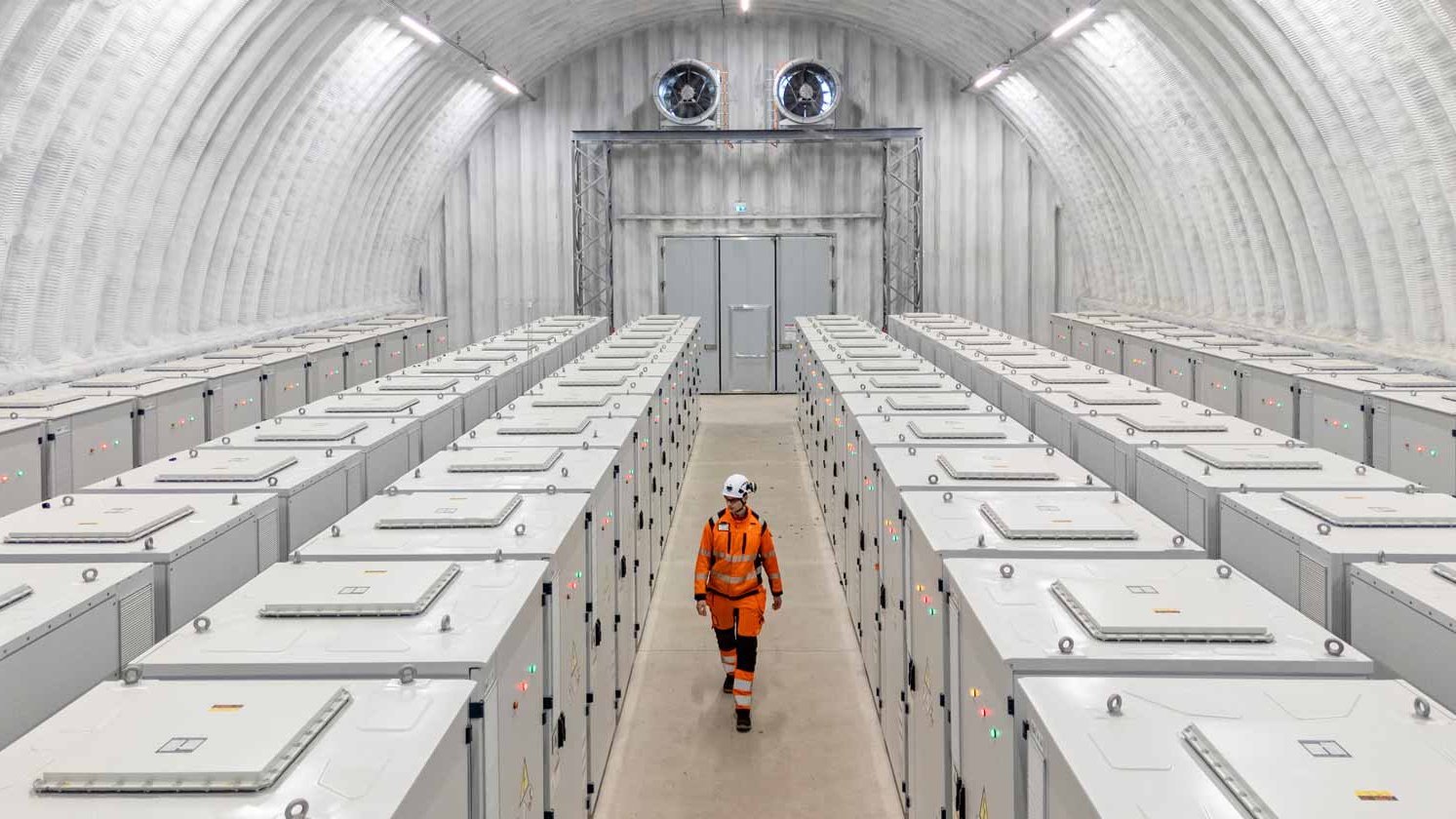
Battery energy storage systems (BESS) play a key role in ensuring the flexibility and stability of future energy systems. Alpiq is investing in this technology to strengthen security of supply in Switzerland and across Europe, while also supporting the integration of renewable energies. What is Alpiq's strategy for BESS? What goals have already been achieved? And what further developments can be expected? We explore these questions with Christoph Bellin, Head of Development & Projects at Alpiq, who is responsible for establishing a pan-European BESS portfolio on a gigawatt scale.
Christoph, Alpiq is pushing ahead with the expansion of its BESS portfolio. What exactly is Alpiq's strategy in the BESS sector, and what are our main goals with this expansion?
Alpiq’s overarching strategy is to significantly scale its presence in flexibility, both through direct investment in our own asset base and through commercial expansion via Origination. The technology has matured, capital expenditure has fallen substantially – driven mainly by reductions in battery cell production costs in recent years – and BESS offers the scalability needed to respond to short-term grid flexibility needs.
Our objective is to complement our already highly flexible hydropower and thermal generation portfolio with a substantial fleet of BESS assets. We see this as a highly synergistic addition to our existing asset base and expect BESS to become a material value contributor for Alpiq in the near term.
BESS is still a relatively new business for Alpiq. The market is growing rapidly and is highly competitive. What lessons have we learned?
This is true – and my view is that Alpiq must adapt to the competitive environment; the environment will not adapt to us. BESS, as a new asset class, attracts capital from outside the traditional utility space. Investor funds and private equity operate at very high speed and efficiency. They set the benchmark. I consider this a positive challenge: Alpiq’s strong balance sheet allows us to invest at scale, but we need to match the pace and discipline of these players.

Our ultimate objective is to build an economically performing BESS asset portfolio for Alpiq.
What external challenges did you encounter as Alpiq entered the BESS market?
Externally, competition for high-quality projects and for talent is intense – much more so than I initially expected. Although BESS technology itself is relatively standardised, the pan-European development landscape is highly fragmented. Local rules, regulatory frameworks, and permitting schemes differ significantly. We underestimated the importance of deeply understanding these local dynamics at the outset, and this has now become a critical success factor. Grid connection availability is another natural bottleneck – and increasingly the limiting factor for scaling many projects across Europe.
Staffing the new organisation was another external challenge. Initially, Alpiq was not perceived as a serious contender in the BESS segment. That changed once we acquired and began constructing our first three large-scale projects. This shift made us a visible and credible player. Given that BESS is one of the fastest-growing global industries, the competition for talent will remain fierce.
And inside the company – what have been the key challenges along the way?
Internally, our priority was to avoid being slowed down by inefficiencies and overly complex processes. We made significant progress here. My team and I operate with a high degree of autonomy – effectively with a “license to act.”
We introduced the BESS Fast Track M&A process, with a clear mandate and streamlined governance: a single steering committee for all projects, fewer decision gates, and fewer stakeholders in the approval chain. Now that multiple projects are moving into parallel construction, we expect similar efficiency gains within the construction organisation. Every project generates new learnings, and the challenge is ensuring these insights flow across teams so that we anticipate issues rather than react to them.
Finally, one important learning is not to expect the executive board to have all the answers or provide detailed execution concepts. It is up to all of us – especially leadership – to translate strategic ambition into action and to demonstrate leadership community at every level. That requires a fundamentally different kind of energy!
The integration of flexibility solutions will be crucial for a successful energy transition. To what extent do BESS technologies play a key role?
Today, BESS is, in my view, the only scalable, economically viable and mature technology capable of meeting the rapidly growing short-term flexibility requirements driven by renewable buildout and electrification. In the coming years, BESS will play an even more central role as system needs intensify and reliability standards rise. Of course, BESS is not a universal solution and does not address long-duration or seasonal storage needs. But it is a critical enabler of the energy transition and a key lever in shifting our power system towards net zero.
I also expect demand response and behind-the-meter flexibility solutions to gain relevance in the coming years. As electrification expands and distributed energy resources grow, these solutions will increasingly complement grid-scale storage and form part of an integrated flexibility stack.
Importantly, the role of BESS is now increasingly anticipated and accepted by regulators and grid operators across Europe – though not without a reasonable level of volatility and surprises.
The commissioning of our first 30 MW BESS in Valkeakoski, Finland, in autumn 2025 is a milestone for Alpiq. What does commercial operation of the asset look like?
First, I want to express my appreciation to all colleagues involved. This project extends far beyond my own team, and it has been rewarding to watch it evolve – from contract execution to civil works, through construction, and now into commercial operations.
Commercialisation is fully managed by our trading colleagues through the first level of our in-house BESS Accelerator platform (BESS Accelerator Day 1). This platform enables automated trading and monetisation of battery flexibility across all relevant market segments – ancillary services and wholesale markets. Given my background in energy trading, it is exciting to see how the trader’s role has evolved: from manual execution to something closer to an aircraft pilot – still crucial for safety and exceptional situations, but mainly supervising a highly automated system. The BESS Accelerator is a joint achievement across different teams and business divisions, and it is energising to see the concept becoming an operational reality.
Further BESS projects are underway. Where does Alpiq see additional potential for expanding its BESS growth strategy in the coming years?
The real question is where and how. We have a multi-gigawatt ambition across Europe. To deliver on this, we need to go beyond the obvious. Yes, we will continue accelerating the acquisition and construction of individual projects, but we will also complement this with targeted inorganic growth and investments in leading BESS developers or IPP platforms. For this reason, the team will be strengthened with selected new resources in the very near time. We are also partnering with selected developers earlier in the process through development and option agreements. This approach has already proven successful: we recently secured a pipeline of three projects totaling more than 400 MW in Germany. I’m proud of this achievement – delivered under intense time pressure, from concept to execution in just two months. Kudos to the legal team for their outstanding support!
Geographically, we are actively looking beyond our current core markets – Switzerland, France, Italy, Germany, Spain and the Nordics – and we are evaluating additional markets such as the UK, Poland, and the Benelux region. What we want to avoid is ending up with scattered, small-scale “BESS islands”. Any market we enter must offer clear growth potential and a sustainable long-term outlook for BESS.
I understand the desire for firm targets and fixed roadmaps, but while we strongly believe in the long-term value of flexibility, delivering on this ambition requires continuous reassessment of focus areas, agility in adjusting priorities, and readiness to pivot when needed. The ultimate objective is not merely to accumulate gigawatts – it is to build an economically performing BESS asset portfolio for Alpiq.