Sustainability

Successful start to the preservation of cultural landscape and biodiversity

01/28/2026, 10:18 | Better climate

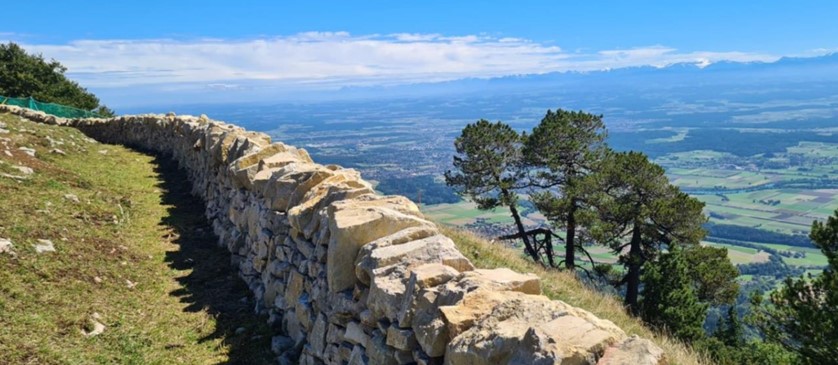
In the summer of 2025, the Naturkultur association successfully completed the first stage of a multi-year dry-stone wall restoration project on the Stallflue above Lommiswil (Swiss Canton of Solothurn) with financial support from the Alpiq Green Fund and other partners. The aim of the project is to professionally restore the historic dry-stone wall, which is a defining feature of the landscape that not only represents the cultural heritage but also makes an important contribution to biodiversity.


As part of the pilot year, around 60 metres of the 500-metre-long dry-stone wall on the south side of the Stallflue were restored over a period of three weeks in August and September 2025. The work was carried out under the supervision of professional dry masons from the Naturkultur association, with support from dedicated volunteers from the Selzach/Solothurn region. The stone material used came from the local Firsi quarry in Grenchen and was transported to the exposed construction site with the support of Leberberg forestry business.

Teaching traditional crafts

One of the aims of the project was to teach traditional craftsmanship. As such, volunteers were given the opportunity to learn dry masonry from scratch under expert guidance – from selecting and working with the stones to constructing the wall properly. In addition to the craftsmanship experience, the project also offered the participants a valuable time out in the great outdoors, fostering interaction and a sense of community.

We want to actively contribute to preserving valuable cultural landscapes and promoting biodiversity in Switzerland.

Reto Fedeli, responsible for Alpiq Green Fund

Contribution to preserving biodiversity

The restored dry-stone wall runs along the Jura Crest Trail and the famous Planet Path and is clearly visible to hikers. It protects people and animals from falling and counteracts snowdrifts. Targeted measures such as creating passages and nesting sites for small animals, conserving perennials and trees and using local stone material ensure the project actively contributes to preserving biodiversity.

The project was financed by contributions from various institutions, including the Alpiq Green Fund, the Federal Office for the Environment (FOEN), the Office for Spatial Planning in the Canton of Solothurn and the Swiss Landscape Fund. The pilot phase in 2025 forms the basis for the further restoration of the entire wall, which is planned for a total of four years until 2028.

“We want to actively contribute to preserving valuable cultural landscapes and promoting biodiversity in Switzerland with the commitment of the Alpiq Green Fund. The Stallflue project is an exemplary combination of nature conservation, volunteering and regional identity. We are delighted to be part of this long-term commitment and to continue supporting the project in the coming years,” says Reto Fedeli, responsible for Alpiq Green Fund.
Impressions

Next stage in the summer of 2026

Following the successful completion of the pilot phase, planning has already begun to continue the project over the coming years, with further sections of the dry-stone wall to be restored so that the entire 500-metre-long wall will be completed by the end of 2028. The next stage, in the summer of 2026, plans to increase the number of masons and working weeks and to take additional safety precautions along the exposed construction site. The stone material that has already been stored is ready for when the project continues. The Naturkultur association continues to rely on collaboration with local partners, volunteers and funding institutions in order to successfully continue the project and preserve the unique cultural landscape of the Stallflue for future generations. 

Looking for volunteers

Anyone interested in volunteering for restoring dry-stone walls on the Stallflue should contact the “Naturkultur association – non-formal learning through exchange and nature programs/Interkulturelles Lernen durch Naturarbeit und Begegnung”. In 2026, the restoration work is scheduled to take place from 17 August to 3 September. 
More information is available at https://www.nakultur.ch/en.

About the Alpiq Green Fund

The Alpiq Green Fund provides financial support to projects that enhance the ecological value and improve biodiversity in Switzerland, particularly in terms of water. The funds come from the sale of guarantees of origin from Alpiq Hydro Aare’s Ruppoldingen run-of-river power plant, which has received the naturemade star certification. The fund was launched in 2010 and has since provided more than CHF 8 million to help around 150 projects create, preserve or revitalise valuable habitats for animals and plants. The fund is topped up every time a guarantee of origin from the Ruppoldingen run-of-river power plant is sold. This directly benefits nature and the environment.