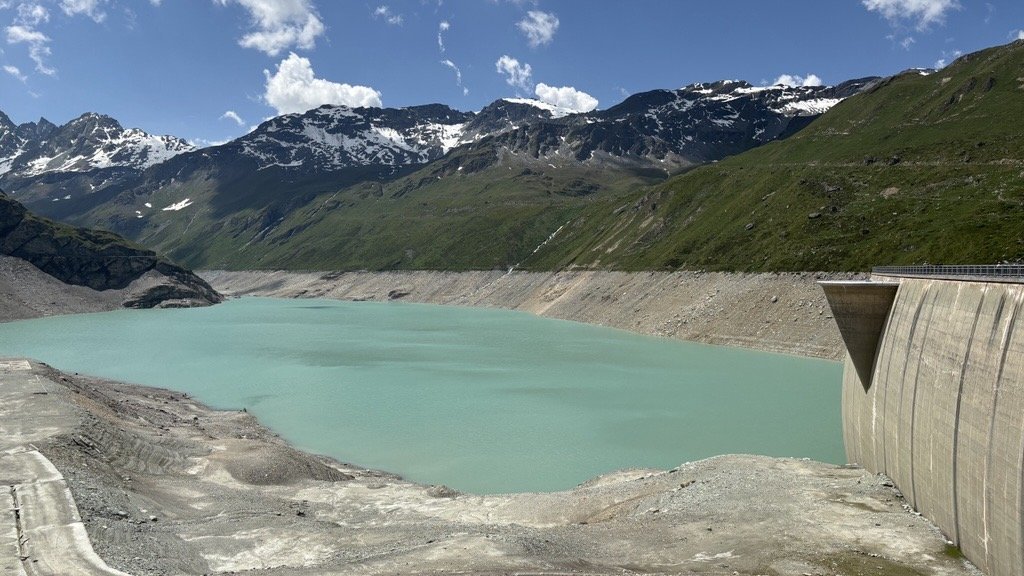
In a nutshell: Low water levels in Swiss reservoirs are a key warning sign for the electricity supply. They highlight the close interdependence between hydropower, weather, climate, storage facilities, grids and European electricity trading. Switzerland therefore needs not just a single solution, but an energy system that is more resilient, more flexible and better coordinated.
Why is there so little water in Switzerland’s reservoirs in the summer of 2026?
The low water levels in many Swiss reservoirs have attracted considerable media attention in recent weeks. According to data published on an ongoing basis by the Swiss Federal Office of Energy, the fill rate of Swiss reservoirs stood at around 52 per cent on 23rd of July 2026. This is significantly below the usual level for this time of year and highlights just how dependent hydropower is on snow, rainfall and temperature trends.
Lakes that rely primarily on snowmelt and rainfall are particularly affected. In these cases, a winter with little snow, combined with persistent drought in spring and summer, has a direct impact on the inflows. Plants with significant glacial inflows, particularly those in regions such as Valais, are less severely affected. They continue to receive water even during hot summer months – though this is not a reliable long-term advantage, as the glaciers continue to retreat.
What do low reservoir levels mean for the electricity supply?
Low reservoir levels do not automatically mean a power shortage. However, they are an important indicator of security of supply, particularly with a view to winter. Reservoirs function like a seasonal battery: water stored in summer can be used to generate electricity during the winter months, when consumption is higher and less solar power is available.
The key question is therefore not how Switzerland copes with a single dry summer. What matters is how the energy system as a whole can become more resilient. Security of supply does not come from a single technology. It arises from the interplay of generation, storage, grids, flexible consumption and international electricity trading.
What role does hydropower play?
Hydropower remains a key technology for Switzerland’s electricity supply. It supplies around 60 per cent of the electricity produced in Switzerland, is renewable, and offers the possibility of storing large amounts of energy seasonally. Thanks to its high flexibility, hydropower also supports the stability of the electricity system. For decades, reservoirs have enabled water collected during the summer to be used for electricity generation in winter. It is precisely this capability that will become even more important in the future.
With the expansion of storage capacity through the projects identified by the “Round Table Hydropower” initiative, Switzerland will be able to store even more energy over longer periods and then use it when electricity or water is in short supply. At the same time, it is important to remember that even in Switzerland – the ‘water castle’ – water must be used carefully. Hydropower is powerful, but its availability is not unlimited.
Why are battery storage, solar energy and wind power needed?
Additional flexibility in the electricity grid is becoming increasingly important. Battery storage can balance out short-term fluctuations within a day for a few hours. It helps to use solar power more efficiently and makes it possible to retain valuable water in reservoirs for the winter, rather than having to use it for flexible electricity generation as early as the summer.
Equally crucial is the expansion of renewable electricity generation. Photovoltaics supply large amounts of energy, particularly in summer. Wind power can make a significant contribution, especially in winter. Together, hydropower, solar energy, wind power and storage increase domestic electricity generation and lay the foundations for the decarbonisation of transport, heating and industry.
What is the connection between low water levels and the electricity agreement?
Switzerland is physically closely integrated into the European electricity system. An electricity agreement with the EU is therefore a key building block for a resilient energy system. It can strengthen security of supply, grid stability and electricity trading. Without reliable integration into the European electricity market, security of supply becomes more difficult and more expensive.
Why does the long-term operation of existing nuclear power stations remain relevant?
The transition of the energy system will not happen overnight. New power stations, storage facilities and grid infrastructure require time for planning, authorisation and construction. The safe, long-term operation of existing nuclear power stations therefore remains a key component of the transition phase – particularly for strengthening security of supply during the winter months. The existing nuclear power stations provide the necessary breathing space to systematically expand hydropower, photovoltaics, wind power, battery storage and grids.