Contact
Media Relations
T: +41 58 833 83 33
media@alpiq.com
Lausanne – Alpiq is advancing its battery storage project in Niedergösgen in the canton of Solothurn. By submitting its planning approval application to the Federal Inspectorate for Heavy Current Installations (ESTI) and initiating the procedure, Alpiq has reached another important milestone towards implementing the project. With an output of 300 megawatts (MW) and a storage capacity of more than 1.2 gigawatt-hours (GWh), the planned facility will be among the most powerful battery storage systems in Switzerland.
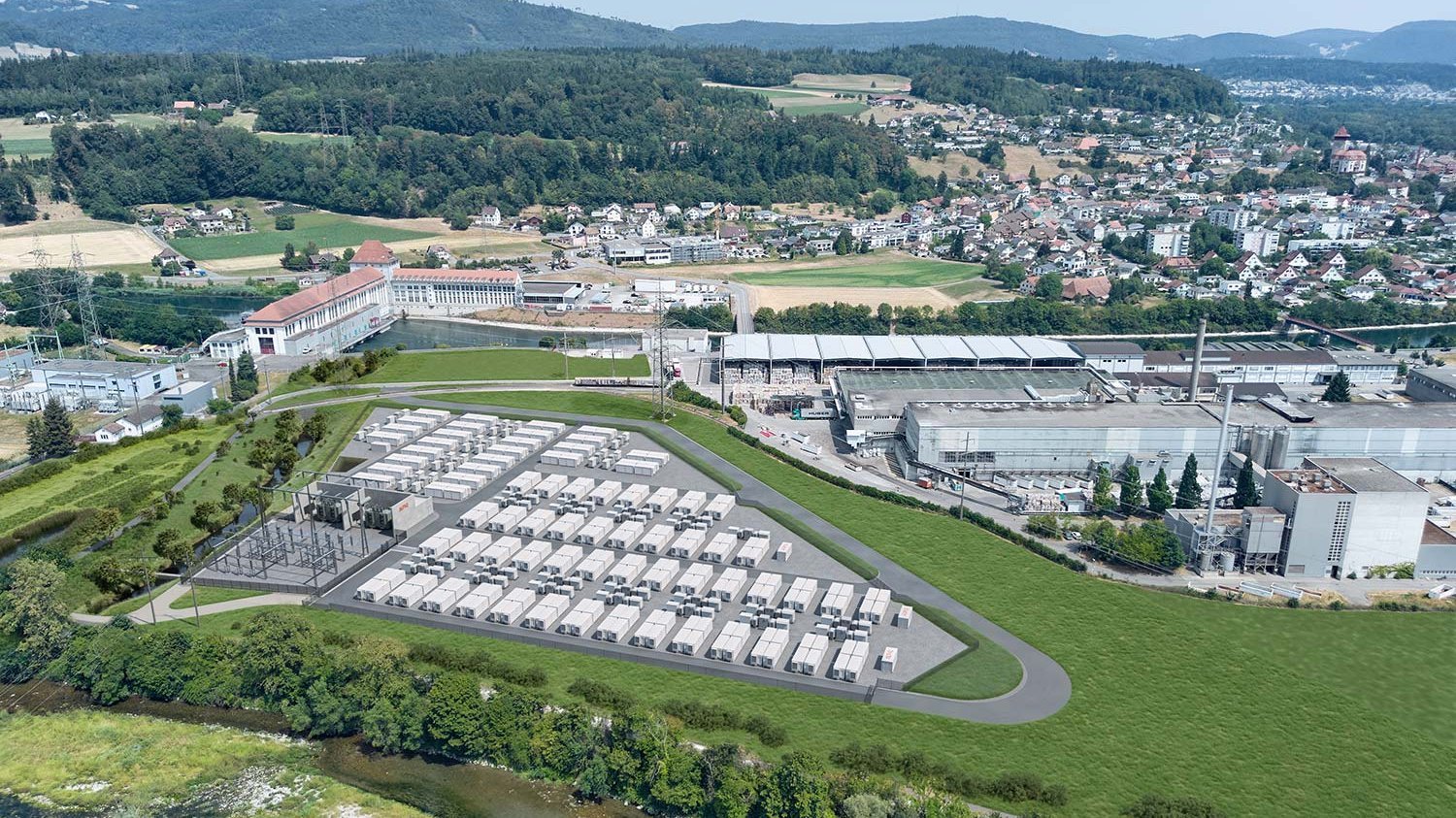
The battery storage facility is planned for land owned by Alpiq in the Grossacker area of Niedergösgen, between Alpiq’s Gösgen hydropower plant and the Old Aare. Its proximity to existing energy infrastructure and a major grid connection point provides favourable conditions for a facility of this scale. The project reached its first major milestone in June 2026, when an agreement in principle with Swissgrid secured 300 MW of connection capacity to the national transmission grid.
The start of the planning approval procedure with the Federal Inspectorate for Heavy Current Installations (ESTI), the authority responsible for granting approval, and the forthcoming public consultation mark the next step towards implementing the project. The plans provide for 72 groups of four battery containers each, together with the technical equipment required for power conversion and grid connection. Construction and design will be coordinated with the neighbouring project for a new fish pass.
Alpiq is committed to keeping local residents and the host municipality informed in a transparent manner. An information event for residents of Niedergösgen will take place in mid-January 2027, when the project team will present the plans and answer questions. Construction is scheduled to begin in 2027, subject to the necessary approvals, with commissioning planned for 2029.
As solar and wind power expand, demand is growing for flexible facilities that can balance fluctuations between electricity generation and consumption. Battery storage systems can absorb electricity when supplies are plentiful and release it when needed. They therefore enable more effective use of renewable energy, help stabilise the electricity grid and strengthen security of supply. When fully charged, the large-scale battery planned for Niedergösgen could theoretically meet the electricity needs of around 500,000 households for more than four hours.
The project forms part of Alpiq’s growth strategy for flexible assets. The company is systematically expanding its battery storage portfolio in its core European markets while also investing in pumped-storage hydropower. Battery storage complements the existing power plant portfolio and increases Alpiq’s ability to respond quickly to changes in the electricity system. With Niedergösgen, Alpiq is also developing a major storage project in Switzerland, building on its longstanding commitment to electricity supply at the site.
For more information about Alpiq, visit www.alpiq.com.